



AeroSentry
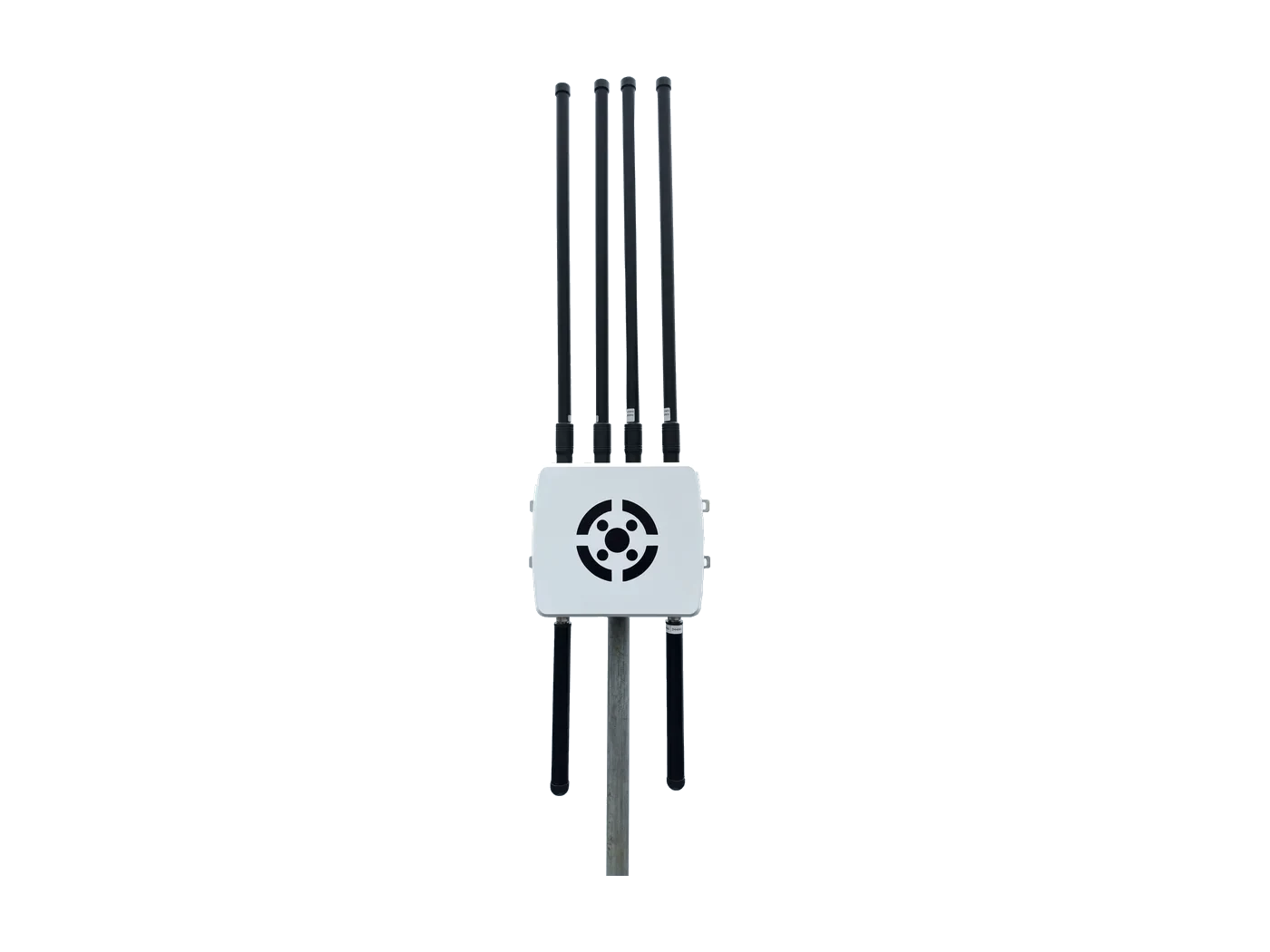
AeroSentry listens to the radio frequency environment around your site and picks out the signals drones and their controllers use. Security teams know a drone is there before anyone can see it, where it is coming from and where it is heading.
What AeroSentry does
- Detects drone RF communication signals in real time
- Identifies drone activity before visual confirmation is possible
- Gives the orientation of an incoming drone for an informed response
- Picks up drone Remote ID and Drone ID signals up to 5 km away
- Receives ADS-B data from equipped aircraft up to 80 km away
- Reports directly into AeroTracker
Two systems, one platform
AeroSentry Zero monitors compliant aircraft and drones. It receives ADS-B and remote ID data and meets the ASTM F3411-22 standard.
AeroSentry One detects supported drone transmissions beyond standard Remote ID, including compatible proprietary drone-identification signals, and sends the full picture to AeroTracker. AeroSentry can run on its own or as one layer of a wider counter-drone system.
Passive RF detection needs the drone to be transmitting. For drones that are not transmitting, AeroSense radar adds a complementary layer.
How it works
Scan
Monitors the surrounding RF spectrum for drone communication activity.
Analyse
Processes the signal data to identify and classify the drone.
Identify
Shows the detection in AeroTracker in real time.
Specifications
Figures as published by Drone Defence. Performance depends on site conditions. We confirm ranges for your site during survey.
- Detection type
- Passive radio frequency
- Frequencies (One)
- 2.4 GHz, 5.8 GHz, ADS-B 1090 MHz, 978 MHz
- Range, drones (One)
- Remote ID and Drone ID up to 5 km
- Range, aircraft (One)
- ADS-B (1090 MHz) up to 80 km
- Range conditions
- Depends on the transmission type, drone, installation and operating conditions
- Standard (Zero)
- ASTM F3411-22
- Data rate (Zero)
- Every 1 to 5 seconds
- Enclosure (Zero)
- IP65
Questions
How far can AeroSentry detect?
AeroSentry One detects supported drone radio transmissions and receives ADS-B data from suitably equipped aircraft. Drone Remote ID and Drone ID signals can be picked up at up to 5 km, and ADS-B aircraft data at up to 80 km. Range and the information available depend on the transmission type, the drone, the installation and operating conditions.
Is AeroSentry One integrated into AeroTracker?
Yes. Detections appear in AeroTracker in real time.
Does AeroSentry transmit anything?
No. It is a passive receiver, so it does not interfere with other systems.
What are the dimensions of AeroSentry One?
Power box 300 × 400 × 180 mm. Sensor box 220 × 250 × 50 mm. Antenna 300 × 20 mm, or 600 × 20 mm for the long-range antenna.
Works with
- AeroTrackerDrone flights and manned aircraft on one live interface, with warning zones and alerts.
- AeroSenseCompact radar that establishes a drone track in under a second.
- AeroEyeAI video analytics that confirm, track and record drones, at up to 5 km with a suitable camera.
- SkyFenceAn electronic barrier along your perimeter that disrupts drone control links.
Deployed for Oil, gas and critical infrastructureStadiums, arenas and eventsAirports and transportPrisonsCorporate securityAirspace management
Talk to us about AeroSentry.
Tell us what you need to protect. A member of our team will be in touch as soon as possible.